Friday the 13th - Small Craft Advisory
On Friday I've been at anchor for two weeks and have endured back-to-back storms. Friday's forecast predicted sustained winds in the mid 20's, with gusts in the mid 30's. Tamer than the prior storm with sustained winds in the mid 30's and gusts in the lower 40's. This one should be easier.
As dusk approached and the wind started to howl I spotted a patrol boat making it's rounds about 100 yards away. I decided to use the extra margin of safety to re-inspect my ground tackle (windlass, cleats and 50' anchor rope since all 100’ of chain was played out). The patrol boat immediately cut speed, turned toward me, and waited diligently for me to traverse the unprotected foredeck.
Everything was exactly as I set it earlier. The patrol boat waited until I was back in the cockpit before resuming its duties. It felt good to have backup. I noticed the waves were much stronger than the last storm, but the wind wasn’t as fierce.
I decided to keep watch all night, slipped into a sweatsuit and settled in with a book.
About 4 hours later I heard a ‘POP” and the boat lurched sideways. As I started to sit up the anchor alarm started blaring. It would be an hour before I could reach the cut-off switch.
Quickly, I donned my life vest, and then went to the electrical panel and turned on all of the exterior lights and power to the navigation systems - just in case. Back up to the main cabin I grabbed my headlamp, hand held signal torch and put my deck sandals on.
In less than two minutes I burst out of the cabin door and into the storm.
The air is cold, the wind is howling. The hand torch is useless - the moisture in the air bounces the light around in a dazzling fashion. I hit the power button to activate the radar, sonar and chart plotter.
F&P is pointed the wrong way and is drifting fast toward a seawall. Either F&P has lost its anchor, or the anchor is dragging. Neither is particularly good.
I immediatly understand there are three possibilities.
1) The anchor is lost but I’m trailing the anchor rope / chain. In that case I have to bring them aboard before I start the engines - otherwise they can foul the props.
2) The anchor is dragging. In that case I need to pull the anchor off the surface, head deeper into the anchorage and re-set the anchor.
3) The anchor is lost, but the line broke above the waterline, at the point of greatest stress - the cleat or the chain box.
I don’t have to venture far before I spot the frayed anchor line on deck, bathed in the red light of my headlamp. I am lucky, the ony way to recover from #1 or #2 is to stay on the foredeck and operate the winch.
Back to the helm. The engines take a few seconds to lower into the water, as I start the first of the two engines I glance at the seawall just as F&P makes not-too gentle contact. The engine starts, but it’s the wrong engine to pull away with. It will push the nose of F&P into the seawall if operated alone. Another, more forceful impact with the seawall. I am startled, then calm. The starboard engine starts, the one that will swing the nose of F&P away from the seawall. Being a child of the 70’s “Punch it chewy” forms in my mind. I do just that.
I’m not quite anchorless. The day before I set up an emergency bridle with 100’ of anchor rope and the backup anchor. But no chain. They are sitting on the foredeck. My pre-incident plan was to chuck it overboard the instant I ran into trouble. I move F&P to the right spot. And I realize that the plan is flawed.
Actually, It’s the perfect plan if the standby anchor holds. But only if it holds.
It is deeply flawed if the anchor drags. The lines are tied to the cleats at the very front of F&P. I can’t use the engines with the lines in the water unless I am set up to bring the anchor line in as I operate the engines. I am not setup for that.
The nose of the two hulls is completely exposed. Not someplace I can venture alone, in a strom, to perform time-consuming tasks. Time I don't have. I rule out using the backup anchor in this small anchorage.
The wind is blowing West to East and I’m on the West side of the Chesapeake. I have to make a run for the deep waters of the Chesapeake. Once I'm miles from land I can leave the helm. The alarms blare, the same aroogah as in the movies. I head for the shipping channel. Another alarm bleats, the GPS has lost its fix.
The sonar shows a depth of 10, then 14 then 20, then 40 feet. I’m in the shipping channel. Not a container ship in sight - a good sign. With the GPS offline, I don’t have a bearing or electronic charts. However the wind is driving straight West, which is where the channel goes.
Soon I’m in deep water, 80’ and growing deeper. No ships, much less pleasure vessels in sight. Spray from a wave reaches the helm station. Then another, finally the chartplotter comes online and shows that I am right where I wanted to be. In the center of the shipping channel, too deep to anchor but in zero danger of running aground.
I switched to radar - which is offline (hadn’t turned it on at the panel). Grrrr. Miles away I can see a huge ship and I reckon that if anyone is closer I could see them too. I’m alone.
I plunge into the cabin, wet, VERY cold and my first order of business is to shut off the anchor alarm.
In the silence, alone on the Chesapeake during a small craft advisory, I realize that F&P is giving zero shits about the wind, 3’-4’ waves, and certainly not the sleet. She is a fabulous sailing vessel. I put on a night watch cap, a wind breaker and take stock.
Some good news. The windmill has the batteries pegged at 100%, I can run the navigation equipment forever on windpower. I move back to the helm and cut the engines. I’m adrift and F&P still doesn’t care, steady as a rock. Everything I had read about her being an accomplished circumnavigator rings true.
Into the cabin. I grab a waterproof tablet, and open its chartplotter software (OpenCPN rocks). That point of failure is eliminated.
Sailing gloves are next. I look at my bare feet in deck sandals and realize I have nothing with a good deck grip that can keep them warm. Of course.
I grab the shortwave radio and turn it on to channel 16, which the Coast Guard and every ship monitors. Next the flare pistol, a knife and finally the tablet. Out into the storm.
The tablet has no place to sit. I lean it against the bulkhead by my feet. Then arrange the flare pistol next to it, and with growing dissatisfaction note that the radio has no place either. I clip it onto my belt and tuck it under my rain coat.
I check the fuel tanks. Little red tanks that look more in place on a johnboat.
Enough to reach the marina, but not much more.
F&P still gives zero shits, even adrift, of the storm howling around us. I recognize that I have time. I inspect everything on deck, the dinghy, lines, windlasses, chain lockers. Everything is as it should be, but I haven’t been critical enough of any of it. A month ago I should have entered into my current mindset and roleplayed such a situation.
I would have prioritized sorting out the 40 gallon fuel tank / filter rather than rely on the ad-hoc pair of outboard tanks that I inherited. I would have made sure that all important equipment, including backups and emergency gear had a secure place within reach of the helm.
And why aren’t I wearing (no, why don’t I own) neoprene deck shoes? Why is the dinghy in the water, where it could (although unlikely given how it is tied) foul a prop? Why can’t I operate the chain windlass from the helm? I lost a precious minute and hit the seawall because I had to carefully navigate up front and determine the state of things. A situation that would have been MUCH worse if I had to stay and operate the windlass using the deck switches next to it. All the while hitting the seawall. Why don’t I have safety lines rigged and a harness to clip onto said lines? Why could a single broken line set me adrift? Why didn’t I upgrade the ground tackle that I identified as too small for this boat in a storm? Why don’t I have mast mounted deck lights?
WHY indeed? I’ve spent half a decade performing risk assessments and didn’t put that practice to work on F&P. That is why I smacked a seawall. That is why I’m standing in the cold, adrift on the Chesapeake in soaked sweatpants and bare feet while rain and sleet relentlessly pelt. I have been complacent, and complacency kills.
The chart plotter indicates that I haven’t drifted nearly enough to be concerned. Back into the cabin. First I turn on the cabin heater. I take my anti-seizure meds, prophylactically. Wash the pill down with a full bottle of water. Stuff another bottle into my jacket. Switch out of the soaked sweatpants and into something water repellent. The external power pack for my phone, that I keep charged for emergencies - yeah that belongs in the pocket of my foul weather jacket. I grab a can of chili and stab a spoon into it, then it’s back outside. On the way out I grab my phone and stick it in a waterproof pouch. Next my sunglasses. An hour into this mess and I’m finally dressed for it.
I go outside and realize just how good the cabin heater is. It is MUCH colder at the helm.
We are pointing somewhat into the wind and spray from a wave breaks over the bow. I need to head north, to the marina and dock at a friendly dock. The bay there is larger than the anchorage that I left. The beaches are sandy enough to beach F&P if I must.
The next hour goes smoothly. F&P handles like a dream. The dinghy bobbing in its wake while I feed myself. I contact the marina and we discuss the best course of action.
The marina is situated in a bay and the entrance to the bay is a narrow channel. I plan a course into the protection of the bay, and anchor there within sight of the marina until the storm passes. The channel into the marina is far too narrow to attempt in the night in any circumstance.
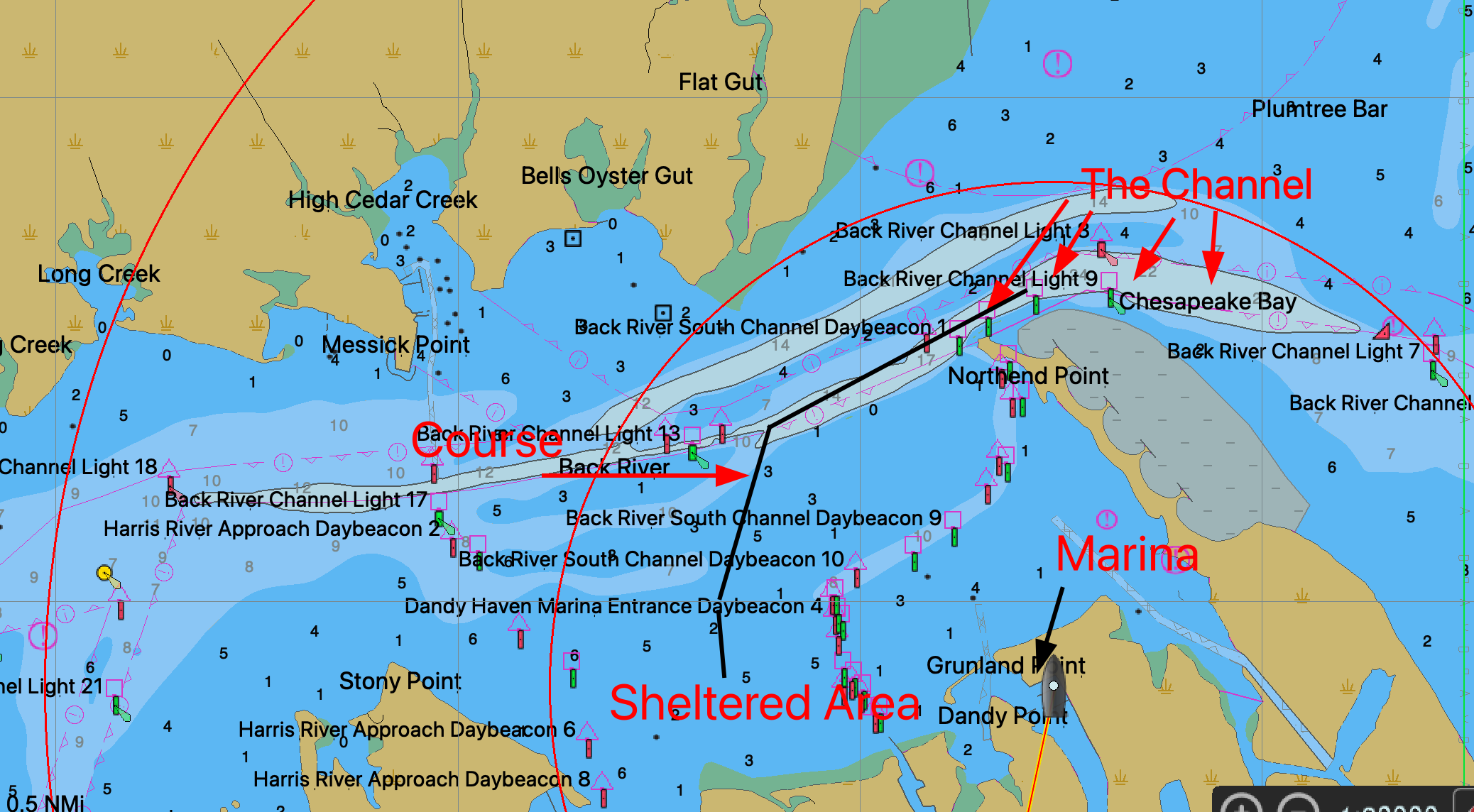
As F&P turns West into the channel she starts to move sideways and starts to spin. The wind and current are having their way with her. The rudder isn’t producing any command authority. I put the starboard engine in reverse and the port engine full forward. She finishes her spin instantly and is pointed East. She is nimble but she also doesn’t bite the water. Like a water spider she sits atop of it. There is a dagger-board that can be lowered to give her some bite, but the bay is far too shallow to use it.
In the deep water of the Chesapeak the current wasn't an issue. Lesson learned.
I have less than an hour’s worth of fuel. I have no choice but to drop anchor and wait the storm out. I anchor snug(ish) near the shoreline. Turn off the engines and go inside. Wool socks (thanks Mom!) and a sleeping bag. I set, and double check the anchor alarm. Set an alarm for an hour from now, afraid I could fall alseep. Then I open the weather forecast and the tide charts. A lucky break, in three hours the storm will subside, an hour after that is sunrise. It would be best to raise anchor and enter the marina at high tide. Instead I decide to stay in the cockpit until I have plenty of light to raise the anchor.
I set an alarm for 1, 2 and 3 hours from now. At each hour I inspect the emergency anchor lines. Everything holds, and the wind howls until daybreak.
My makeshift anchor line is too large for the anchor windlass. I attach a smaller line to the anchor line, and use the windlass to pull it aboard. Every 10’ of progress requires that I cleat the anchor line and reposition the smaller one. After a few repetitions I have enough line to reach the windlass for the sail. This windlass is at the helm, where I can also control the engines. It is a manual windlass, but the mechanical advantage it provides is insane. I throttle slowly forward, cranking the windlass to bring in the slack as I go. It is slow work, but manageable. Soon the anchor is aboard and I make my way to the marina.
Bill, the dock master, contacts me and coaches me through the channels. It is a tricky passage, I am fatigued, and there is still significant wind. We make it to the dock.
The rear swim platform (aka sugar scoop) has some minor damage from striking the seawall twice. There is also damage to an eyelet that the dinghy was attached to. I had noted earlier that the eyelet seemed to be weakly bedded. It was.
The broken anchor line (aka rode) was especially frustrating. F&P was outfitted with ¼” chain when I got her. That gauge of chain is far too small for the loads that F&P can generate at anchor in a storm. Performance racing boats aren't anchored in storms and I didn't reevaluate the ground tackle.
Worse, the chain was only 100’ long, requiring another 50’ or so of rode (nylon anchor line) to achieve the correct placement of the anchor.
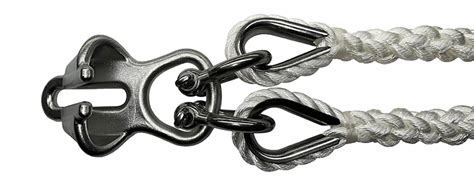
A catamaran the size of F&P should have a full 150’ of 30% stronger 5/16” chain. No rode to break, pure chain with the near end attached directly to a strongpoint in the locker chain. A bridle should be connected directly to the chain to absorb the shock of waves and take the load off of the windlass. This is the standard for anchoring a catamaran.

.
A close-up of the bridle, the cup grabs the chain and is typically tied to it to prevent them from comming apart.
Why was I out on an anchorage running chain I suspected to be undersized for ‘big weather’ and counting on it to hold in ‘medium weather’?
Insufficient risk management is why.
I’ll leave the marina for anchor only after I review all systems, ensure they are sufficient and ensure they can be operated from the helm.
I have a second windlass, ready to install, but first I must reinforce the deck.
Two anchors is a good first step. I don't have to wait for the full systems review to remediate known shortcomings. I've already identified over a dozen changes, some small like a tablet mount at the helm, that I need to make.
- Neoprene deck shoes have replaced the sandals.
- I am waiting for warmer weather so the epoxy will secure the new tablet mount correctly.
- I have purchased a second electric anchor windlass, this one with the essential 5/16' chain pockets. That is a bigger project involving reinforcing the deck by the second chain locker and running additional electrical wires.
- I have a fuel filter and pump to bring the fuel tank back online.
- I also purchased more than enough "wet" epoxy that can be applied even underwater for the deck fitting and fiberglass cracks.
- Remote windlass switches to be installed at the helm have been acquired.
- A risk adverse mindset is the most important change so far.